Welcome to Rio de Janeiro
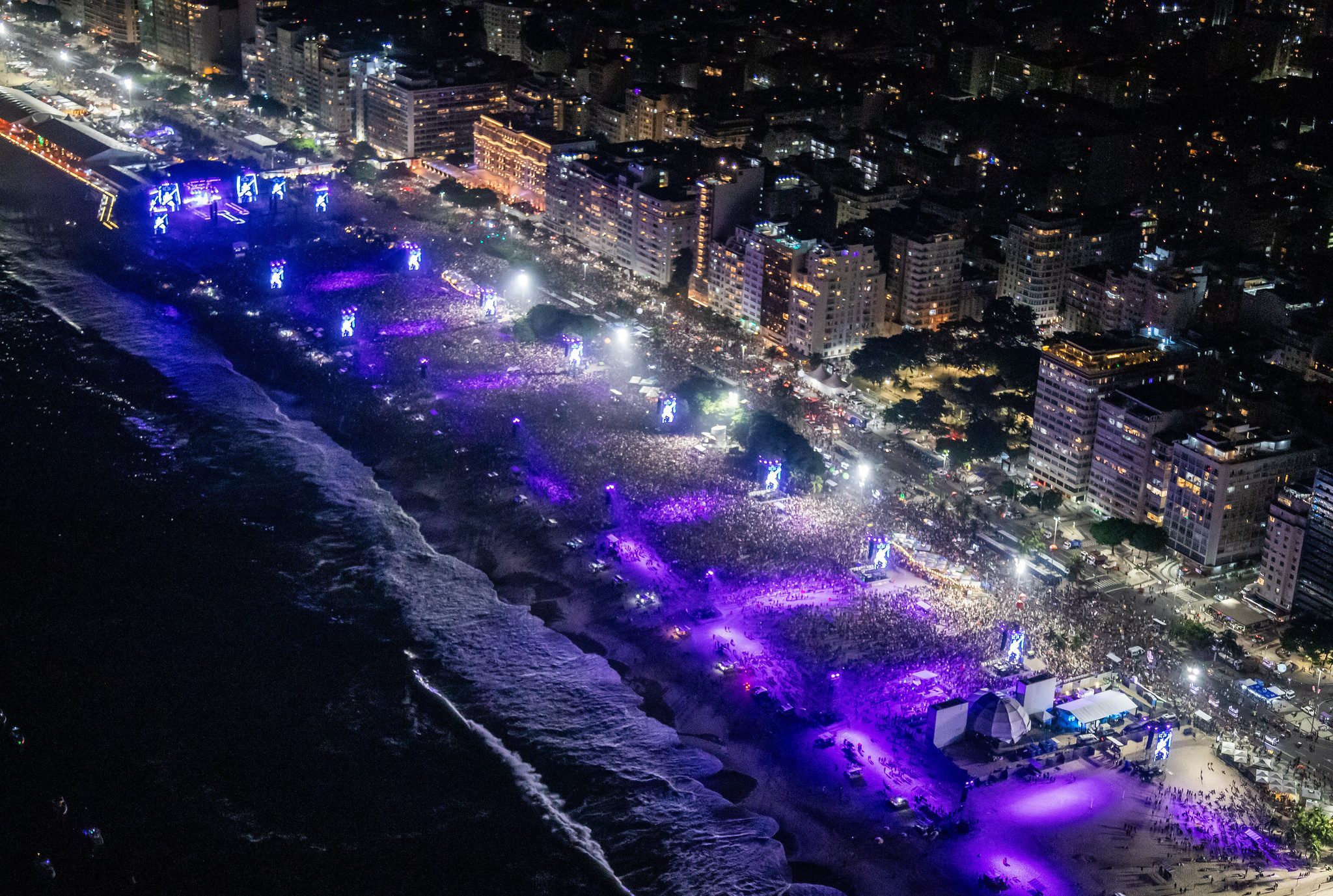
How Copacabana became the world’s biggest open-air stage
Some places carry a myth that words barely touch. Copacabana in Rio de Janeiro is one of them. Four kilometers of white sand, backed by green mountains and the Atlantic Ocean shimmering in every shade of blue. But since May 2024, something has happened here that sets new standards even for Rio. The city government turned this beach into a massive free concert venue. No ticket required. Open to everyone. With artists who normally charge several hundred dollars for stadium seats. Madonna, Lady Gaga, Shakira — three of the biggest pop stars on earth performed before millions of people within two years. Right at the water’s edge. The project is called “Todo Mundo no Rio,” Portuguese for “Everyone to Rio.” It has changed how travelers think about public space, live music, and what a city can offer its visitors.
How a city turned its coastline into a stage
The idea did not appear out of nowhere. Eduardo Paes, the mayor of Rio de Janeiro, pushed the project forward with a mix of political boldness and cold economic calculation. Rio had suffered. The pandemic, economic crisis, and the city’s reputation as a dangerous destination had all hurt tourism. Paes and his team decided to make May a festival month. Not with small street parties, but with concerts that make the world pay attention. The formula is surprisingly simple. The city provides the beach and pays the bill, together with sponsors like Corona, Santander, LATAM Airlines, and Guarana Antarctica. TV Globo broadcasts live across the country. Admission is free. Arrive early, stand near the front. Arrive late, listen from far back. The crowd mirrors the city itself: locals and international tourists, fans, families, retirees, teenagers, couples. Everyone stands in the same sand.
The infrastructure for events of this scale is impressive. A stage on Copacabana Beach means tons of equipment that must be protected from salt water. Thousands of police officers manage the masses. Traffic grinds to a halt across the city. And yet it works. For the Madonna concert, over 3,000 police officers were deployed. The Rio airport recorded 170 additional flights in a single weekend. Hotels along Avenida Atlantica were almost fully booked months in advance. The city proved it could handle these dimensions. It also proved something else. A concert does not have to be just a concert. It can be a social event, an economic engine, and a statement.
The concert that started everything
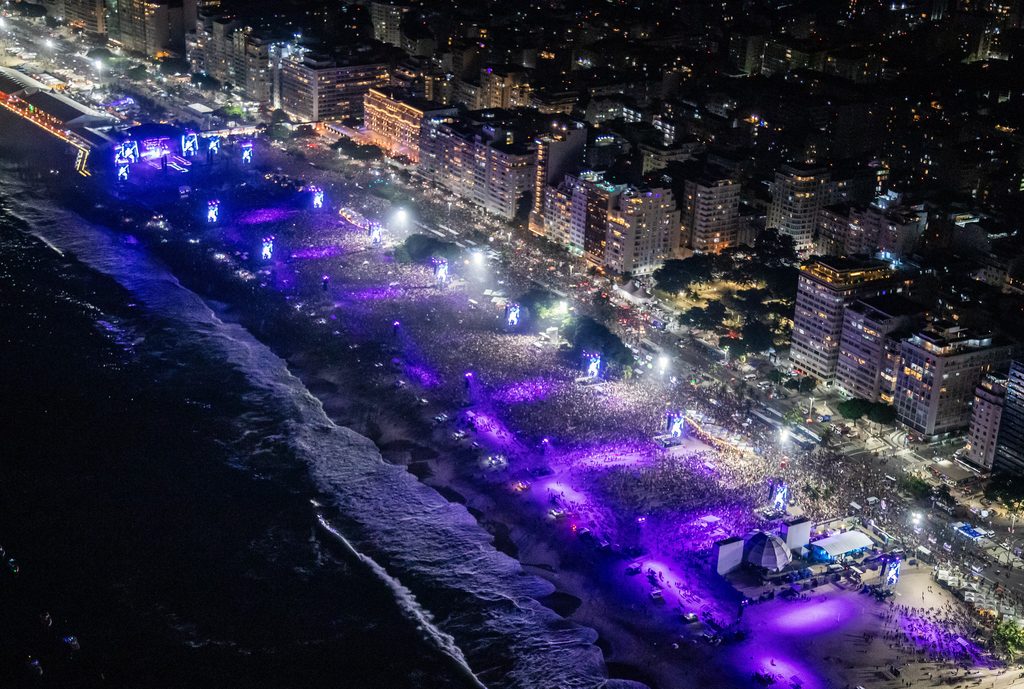
On May 4, 2024, Madonna closed her Celebration Tour with a free show at Copacabana. It was her only performance in South America, the finale of forty years in music. City officials estimated the crowd at 1.6 million. That number sounds unbelievable until you see the photos. People as far as the eye can see, from the beachfront towers down to the waterline. Boat owners in the ocean watched from their railings. Madonna herself seemed overwhelmed. She told the crowd this was the most beautiful place in the world. She called it magic. The audience answered with a single roar. She had not performed in Brazil since 2012, and the longing was visible. Local stars Anitta and Pabllo Vittar joined her on stage. Most spectators knew every word of her hits. The temperature hovered around 27 degrees Celsius. The sea was warm. The air was humid. This was not a normal concert evening. It was a collective experience that only happens in Rio.
The city government reported an economic impact of 293 million Reais, roughly 57 million USD. Whether this figure is accurate or somewhat optimistic remains open. Critics note that official numbers for events of this magnitude are rarely neutral. The city wants to show success. Sponsors want to justify their return on investment. But even if the number is halved, the impact remains massive. Hotels, restaurants, bars, taxi drivers, souvenir vendors — everyone benefits. Madonna posted on Instagram after the concert. Her photo showed her before the ocean of people, arms spread wide. That was the moment when it became clear. This series could make history.
A record broken, a debate ignited
One year later, on May 3, 2025, Lady Gaga took the stage. She arrived with her album Mayhem and a five-act gothic opera format she had already tested at Coachella. Expectations were high. Madonna had drawn 1.6 million. Gaga needed to top that. She did. Official sources reported 2.1 million attendees. The promoter Live Nation claimed 2.5 million. Suddenly there were two truths. The question of who is right is not simple. How do you count a crowd on a four-kilometer beach? By drone from above? By analyzing mobile phone signals? By counting subway entries and exits? Each method delivers different results. The city states 2.1 million because that is what its tourism agency Riotur calculated. The promoter claims 2.5 million because bigger numbers feed the artist’s ego and marketing machine. The truth probably lies somewhere in between. What is certain: this was the largest crowd Lady Gaga had ever faced. And it was the biggest solo concert by a female artist in the 21st century, at least if you believe the promoter.
Lady Gaga knew the scale of the evening and told the crowd they were making history together. Her Little Monsters rose to the occasion, many arriving in looks inspired by different eras of her career. Rio projected the event would generate about 600 million reais for the local economy, or roughly 100 million US dollars, depending on the exchange rate used.
Two million voices on one beach
On May 3, 2026, Shakira performed at Copacabana. Her concert was part of the Las Mujeres Ya No Lloran world tour, named after her 2024 album. Shakira holds a special bond with Brazil. She first visited in 1996, at age eighteen. Thirty years had passed since that trip. The new mayor of Rio, Eduardo Cavaliere, officially confirmed two million attendees. He tweeted after the concert that the wolf had made history in Rio. A reference to her hit She Wolf, which sent the crowd into ecstasy. The show lasted nearly three hours. Drones formed the words “I love you, Brazil” in the night sky. The staging rivaled Hollywood productions. Shakira brought guests who emphasized the Brazilian core of the evening: Anitta for a duet of Choka Choka, Caetano Veloso for Leaozinho, Maria Bethania for O Que E, O Que E?, and Ivete Sangalo for Pais Tropical. This was not an international star show that simply happened to take place in Rio. It was a dialogue with Brazilian musical tradition.
The economic numbers for Shakira’s concert reached approximately 777 million Reais, around 132 million euros or 155 million US dollars. Euronews, G1, and Riotur confirmed this magnitude. Reuters cited 155 million dollars, which at current exchange rates lands in the same range. Notably, the economic effects have grown with each event. Madonna: 293 million Reais. Lady Gaga: 600 million. Shakira: 777 million. This happens because the series grows more famous, attracts more international visitors, and the infrastructure improves. Hotels have learned to adjust prices dynamically. Restaurants offer special menus. Flight traffic intensifies. The mega-shows have become self-perpetuating. And the city announced it will continue the series through at least 2028.
The economics of free concerts
Anyone wondering why a city pours millions into free concerts will find the answer in the tourism data. The Observatorio do Turismo Carioca published figures that document the series’ success. In May 2023, before the first mega-event, 252,700 tourists arrived in Rio. In 2024, the year of Madonna, that number rose to 339,100. An increase of 34 percent. In 2025, with Lady Gaga, the figure exploded to 481,400. Over 90 percent above the baseline. Between 2024 and 2025 alone, 142,400 additional tourists came. These visitors booked hotels, ate in restaurants, bought tickets to Sugarloaf Mountain, took taxis. Among concert attendees, 15.5 percent came from outside the city, including 13.9 percent from other Brazilian states and 1.6 percent from abroad. That sounds small at first. But with over two million attendees, it means tens of thousands of international guests who traveled specifically for the concert.
The city of Rio and its sponsors finance the events. TV Globo, Multishow, and Globoplay broadcast live. The sponsor list reads like a directory of major Brazilian and international brands: Corona, Santander, LATAM, Zé Delivery, Guarana Antarctica. For these companies, this is not charity. It is advertising with a reach that exceeds Super Bowl commercials. A concert with two million people on a beach, plus millions watching on screens, is a platform that no conventional marketing budget can buy. And for the city? It gains international attention that would be unaffordable through any paid campaign. When Lady Gaga performs before 2.1 million people, every news outlet on earth covers it.
How travelers can experience the mega-events
For tourists considering Rio, the mega-shows are an opportunity and a challenge. Anyone visiting in May who wants to catch one of these concerts must plan ahead. Hotels in Copacabana, Ipanema, and Leblon are fully booked months in advance. Last-minute bookers find only accommodations in neighborhoods like Botafogo or Flamengo, which are nearby but not on the beach. Traffic on concert day is extreme. The subway runs, but the cars are as packed as Tokyo rush hour trains. Buses follow detours. Taxis and Uber are scarce and expensive. The insider tip: arrive early. Those who reach the beach in the late afternoon secure a good position. Those who come two hours before showtime stand four kilometers from the stage and see only the screens. Visitors should bring water, sun protection, and patience. Temperatures during Brazil’s autumn, since May falls in autumn here, remain pleasant at 25 to 28 degrees Celsius. But the sun still burns.
Travelers who are not concert fans might consider avoiding Rio during the week of this mega show, usually in May. The city is crowded, prices are high, restaurants are overwhelmed. But for music lovers, for people who want to stand before a crowd of two million at least once in their lives, this is an unmatched experience. It costs nothing. It is open. It is Rio de Janeiro at its most extreme. The city made Copacabana the world’s biggest free open-air stage. Just sand, sea, and music. It proved that public spaces can become something extraordinary when a city takes them seriously. Anyone traveling to Rio in May should watch the news. The series will continue at least through 2028.